
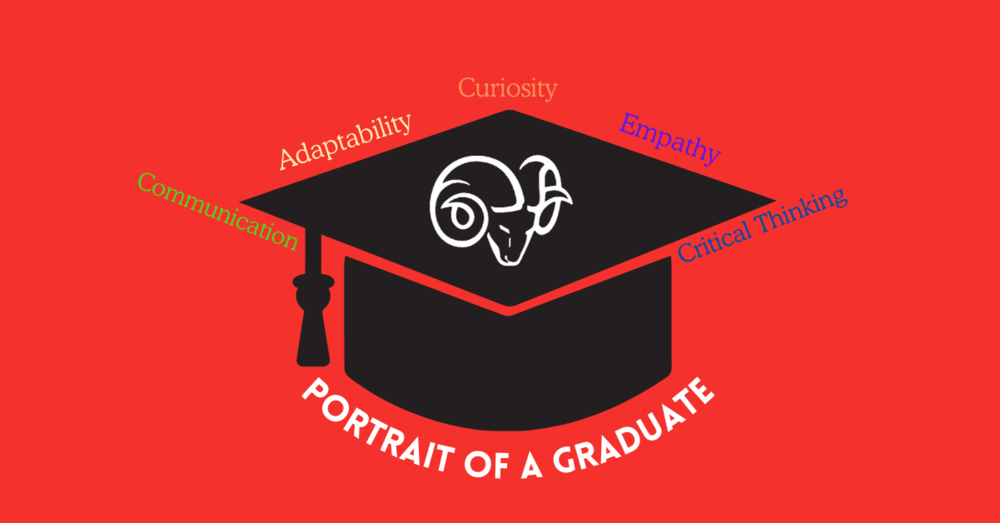
For years, the senior portfolio, or “Portrait of a Graduate”, has served as a reflection of students’ work at NCHS. By revisiting and reflecting on projects from across their high school careers, seniors are asked to consider not only what they produced, but how those experiences shaped them as learners. This year, however, the assignment is changing – placing more emphasis on shared conversation rather than traditional portfolio submissions.
English Department Chair Evan Remley, along with the rest of the department faculty, played a role in developing the assignment for this year’s seniors. “The senior portfolios were the mechanism through which NCHS measured the Portrait of the Graduate framework that requires graduates demonstrate the five competencies of a graduate,” he said. The framework is built around five core attributes: adaptability, empathy, communication, critical thinking, and curiosity.
Choosing “artifacts”, or past assignments for the portfolio that demonstrate each attribute can be challenging. It requires students to reflect on four years worth of work, and can be anything from presentations and essays to lab or performances: “I think the most important thing is that a student is proud of the work they completed,” Mr. Remley said. “I’d recommend anything that required a broad range of skills. Group projects are cool too, as they can make up 2/3 of the artifacts and enable students to discuss the role collaboration and community played in their thinking.”
The changes being made to the portfolio assignment this year reflects broader conversations among faculty and administrators about how students demonstrate growth. “After discussion with the NCPS administration and the PoG committee, we decided to shift to student-led conferences,” Mr. Remley said. “This evolution is designed to prioritize student voice and growth, allowing faculty to engage directly with seniors through probing questions about their learning artifacts and their connection to our core attributes.”
Through the new conferences, students should be able to have a more authentic and dynamic reflection experience. “Our hope is that these will lead to a conversation with faculty members that will be about meaningful experiences for students,” Mr Remley said. “Students will be able to reflect on important moments in their learning journey and the role the NCHS community played in that journey, while faculty will be able to hear from students directly on what assignments, instruction and experiences were particularly impactful for students.”
The faculty is preparing for the conferences in several ways. Science Department Chair Michael LeDuc helps to develop and lead the professional development sessions for the faculty. “Since every faculty member has scored many portfolios, we know what types of artifacts students highlight and how they typically reflect on their growth,” he said. “During our Professional Learning day, we will watch exemplar conferences to calibrate our approach, discuss the types of questions to ask, and clarify our expectations for each student.”
Mr. LeDuc emphasized the collaborative nature of the process. “We all play a role in helping you become the exceptional graduates you are, and we look forward to celebrating you and learning more about your journey at NCHS,” he said.